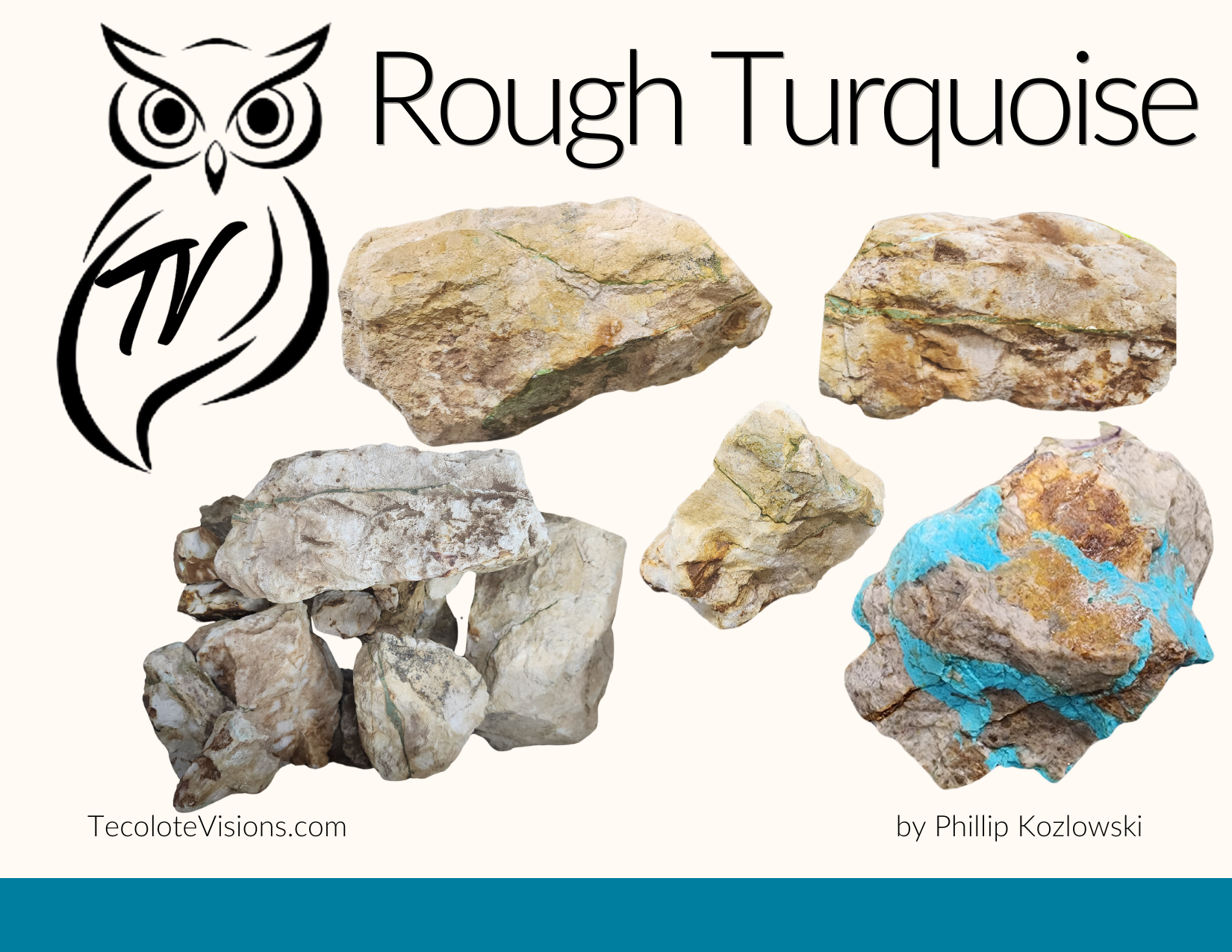
In the sun-drenched deserts of the American Southwest, something magical happens. Beneath layers of earth and time lie veins of turquoise—ancient stones formed by water, copper, and patience. But the true transformation begins when this rough turquoise reaches the hands of a skilled artisan like Phillip Kozlowski of Tecolote Visions.
This is the story of how Phillip takes raw turquoise—rugged, dusty, and unassuming—and turns it into radiant slabs and cabochons that dazzle collectors, jewelers, and turquoise lovers alike. Whether destined for sale through Turquoise Keep or set in his own striking silver jewelry designs, every stone passes through a sacred process—part geology, part craftsmanship, and part alchemy.
From Desert Rough Rock to Polished Stone
Turquoise is more than just a gemstone; it’s a story locked in stone. Its journey begins in the mines—many of which are now closed or tightly regulated—across Nevada, Arizona, and New Mexico. Phillip sources rough turquoise from both historic and active mines, working with reputable and ethical dealers.
Some of his favorite varieties include:
- Royston turquoise: Known for its vibrant greens and deep caramel matrix.
- Hachita turquoise: A rare gem from southern New Mexico, with vivid blues and bold veining.
- Number 8 turquoise: Revered for its spiderweb matrix and buttery golden tones.
- Baja turquoise: A Mexican turquoise prized for its sky blues and dramatic contrast.
- Kingman Ceremonial: A special grade from the legendary Kingman mine, full of bright, clean blues and swirling matrix patterns.
“Each mine leaves its own fingerprint on the stone,” Phillip explains. “I love working with that natural variation—it keeps me grounded.”
Once sourced, the real transformation begins.
The Slab Saw: Revealing the Hidden Patterns
The first critical step in transforming rough turquoise is slabbing, the process of cutting raw, irregular chunks of turquoise into flat, manageable slices. Slabbing is both technical and intuitive—it requires specialized equipment and a practiced eye to assess how to cut the stone to maximize its beauty and yield.
Assessing the Rough
Phillip begins by carefully studying each rough nugget or chunk, considering:
- Color density and variation: Where is the richest blue or green?
- Matrix patterning: Does the host rock enhance or distract from the turquoise?
- Cracks and inclusions: Can they be cut around or stabilized later?
“Each piece is a mystery box,” says Phillip. “You only get one chance to make the first cut, so you’ve got to read the rock.”
Cutting with Precision
Using a diamond-blade lapidary slab saw with a water-based lubricant, Phillip makes deliberate passes through the stone. The process is slow and steady to prevent overheating or chipping. Each slice is typically between 4mm and 8mm thick, depending on whether the slab is destined for cabbing, inlay, or carving.
Here are some tools Phillip uses in his workshop:
- 10″ or 14″ Diamond Slab Saw
- Water-cooled blade
- Custom jigs for holding irregular-shaped rough, but Phillip hand hand-holdsholds all his cutting
Each slab reveals a cross-section of the turquoise’s internal structure—bands of color, spiderweb matrix, and pockets of clarity or quartz. Sometimes the interior is more beautiful than expected; other times, it may be chalky, porous, or fractured.
“It’s like slicing through time,” Phillip notes. “You get to see millions of years of mineral history in a single cut.”
After slabbing, the turquoise is cleaned and dried. At this stage, Phillip decides whether the slab will be sold, stabilized, or turned into a cabochon.
Stabilizing: Strengthening The Rough Stone Without Losing Soul
Turquoise is a hydrous phosphate mineral, which means it often forms in a relatively soft state. While high-grade natural turquoise is hard enough to cut and polish without alteration, many stones—especially those with vibrant color but softer structure—benefit from stabilization.
Phillip performs in-house stabilization for select stones, ensuring quality control and full transparency about the process.
Why Stabilize Rough Turquoise?
- Improves durability for jewelry use
- Prevents chipping and fracturing during cutting
- Enhances color depth and saturation
- Seals porosity to protect from oils and moisture
Stabilized turquoise is particularly well-suited for rings, bracelets, or any piece exposed to regular wear and handling.
The Stabilization Process
Phillip uses a vacuum chamber and high-quality clear resin called cactus juice, to stabilize slabs and preforms. Here’s how the process works:
- Drying – The slab is completely dried in a dehydrator or warm oven to remove all internal moisture.
- Vacuum Chamber – The dried turquoise is submerged in liquid resin and placed under vacuum. This draws the gases from the stone’s pores and fractures. Once the vacuum is released, the resin penetrates into the stone where the gas was.
- Curing – Once fully penetrated, the resin-infused turquoise is removed and baked in an oven to harden it internally.
- Trimming and Polishing – After stabilization, the stone is trimmed and lightly surfaced to remove any excess resin film.
“Stabilizing doesn’t cheapen the stone,” Phillip explains. “It reveals and protects what’s already there.”
Phillip only stabilizes turquoise when necessary and always labels it accurately when selling slabs or cabochons. This transparency is especially appreciated by collectors, jewelers, and lapidary artists who value knowing the full treatment history of a stone.

Cabochon Cutting: Sculpting the Stone’s Spirit
Once the slab is cut, Phillip selects specific pieces for transformation into cabochons. This is where his true artistry comes alive. Using a cabbing machine and diamond grinding wheels, he carefully shapes each stone by hand.
“Some cabs want to be symmetrical and perfect. Others are wild and organic,” he says. “I let the stone decide.”
His process involves:
- Tracing the most visually compelling parts of the slab
- Grinding the shape on a diamond wheel
- Creating a gentle dome to reflect light
- Polishing with increasingly finer grits for a glossy finish
- Flattening and beveling the back for easy setting
The result? One-of-a-kind cabochons with soul. Some are sold individually to other jewelers and collectors. Others become the centerpieces of Phillip’s silverwork.
Silverwork: Giving the Stone a Home
Phillip doesn’t just cut turquoise—he brings it full circle through silversmithing. His bold, hand-fabricated jewelry features traditional Southwest techniques including:
- Hand-stamped accents
- Bezel settings
- Cold connections
- Textured finishes
Each piece of jewelry is built around the stone, not the other way around. Whether it’s a cuff bracelet, bolo tie, or statement pendant, the turquoise always takes center stage.
Phillip often works in sterling silver, adding natural patina to highlight stampwork and stone color. His designs reflect the landscapes he calls home—sun, sky, desert, and stone.
Sharing the Journey: Mentorship
Phillip’s journey with turquoise isn’t just personal—it’s communal. He shares his process openly, offering guidance to aspiring lapidaries and collectors.
On his YouTube channel, viewers can watch behind-the-scenes videos of:
- Slab cutting and equipment setup
- Cabochon grinding techniques
- Turquoise grading tips
- Jewelry setting and finishing
Whether you’re just starting out or looking to refine your skills, Phillip’s videos offer practical advice and inspiration rooted in decades of experience.
Why It Matters: The Heart of Desert Alchemy
Desert alchemy is more than a poetic phrase. It’s a real, tactile transformation—from something rough, opaque, and overlooked into something luminous, beloved, and lasting.
Every slab and cabochon Phillip creates is a meditation on patience, beauty, and process. In a world of speed and mass production, Tecolote Visions offers something timeless—craftsmanship rooted in tradition, respect for the land, and a deep connection to stone and spirit.
Phillip’s work is a reminder that transformation is possible—not just for turquoise, but for all of us.