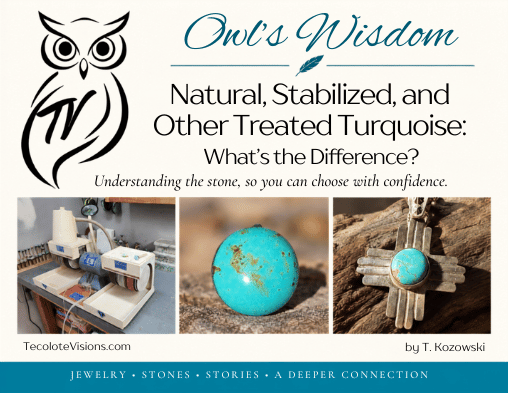
Turquoise has a way of catching your attention. Sometimes it is the clear blue that first draws you in. Other times it is the green, the spiderweb matrix, or a ribbon of color running through the host rock like water through a desert canyon.
But there is something a photograph cannot always tell you: what happened to that piece of turquoise after it came out of the earth.
If you have spent any time shopping for turquoise, you have probably seen words like natural, stabilized, treated, dyed, or reconstituted. Those terms can become confusing quickly, especially when they are used without explanation.
And they matter.
Not because one type of turquoise is always “good” and another is always “bad,” but because you deserve to know what you are buying.
At Tecolote Visions, Phillip works with turquoise from rough stone through the finished piece. He cuts, shapes, polishes, and when needed, stabilizes selected stones himself. Understanding the difference between these forms of turquoise is part of understanding the material he works with every day.
WHAT DOES NATURAL TURQUOISE MEAN?
Natural turquoise is turquoise that has not been chemically altered, dyed, or impregnated with resin or another substance to strengthen it.
It has been taken from the earth, cut, shaped, and polished, but the stone itself remains as nature created it.
High-quality natural turquoise can be dense and hard enough to cut and polish beautifully without additional treatment. These stones are especially prized by collectors, particularly when they come from a known mine and display desirable color or matrix.
But turquoise does not come out of the ground in one consistent condition.
Some rough is hard and dense. Some is chalkier or more porous. Some pieces contain small fractures, softer areas, or host rock that can make cutting difficult.
That variation is part of turquoise.
It is also one of the reasons Phillip studies a piece of rough before making the first cut. The outside of a rock only tells part of the story. What is inside may be completely different.
Natural turquoise also remains porous. Over years of wear, it can absorb skin oils, lotions, dirt, and other substances that may gradually affect its color.
For some collectors, those characteristics are part of the appeal. For jewelry that will be worn frequently, however, a softer stone may benefit from additional support.
That is where stabilization comes in.
WHAT IS STABILIZED TURQUOISE?
Stabilized turquoise begins as real turquoise.
This point is important because stabilization is sometimes misunderstood as turning a stone into something artificial. It does not.
At Tecolote Visions, when we refer to stabilized turquoise, we mean natural turquoise that has been strengthened with clear resin. Phillip does not add dye to change the stone into a color it was never meant to be.
For selected softer or more porous material, the stabilization process allows resin to penetrate the tiny spaces within the stone. Once cured, the stone becomes stronger and better able to withstand cutting, polishing, setting, and everyday wear.
Phillip performs this process himself on turquoise that needs it.
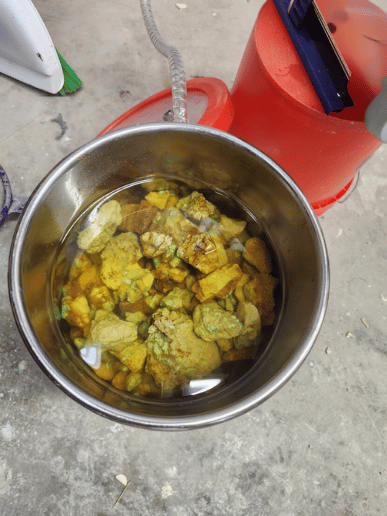
The stone is first thoroughly dried to remove moisture. It is then submerged in clear stabilizing resin and placed under vacuum. The vacuum helps remove air trapped within the porous stone. When the pressure changes, resin is able to move into those spaces. The stone is then cured so the resin hardens within it.
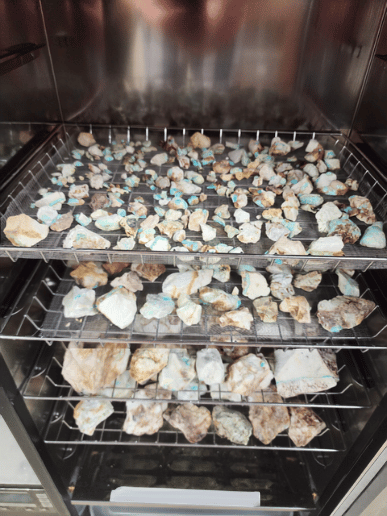
What comes out is still the same turquoise Phillip started with, including its original pattern, matrix, and character. It is simply more durable.
The color may appear slightly deeper after stabilization because the pores have been filled, much like a stone can appear richer in color when wet. That is different from deliberately adding color with dye.
For Phillip, stabilization is not about making a poor stone pretend to be something better.
It is about preserving a beautiful stone that might otherwise be too fragile to become wearable jewelry.
WHY WOULD PHILLIP STABILIZE ONE STONE AND NOT ANOTHER?
The stone makes that decision.
Before cutting turquoise, Phillip looks at its density, structure, fractures, matrix, and overall condition. As the stone is slabbed, more of its character is revealed.
Some turquoise is naturally dense enough to move directly through the lapidary process.
Other material reveals beautiful color or an extraordinary pattern but needs additional strength before it can safely become a cabochon.
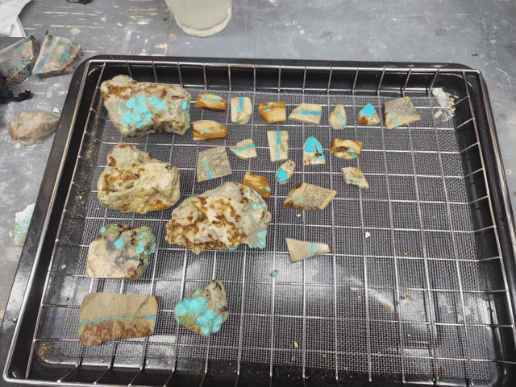
Ribbon turquoise is a good example of why this can matter. Part of its beauty comes from the relationship between the turquoise vein and the surrounding host rock. Depending on the material, those different areas can have different densities and may respond differently during cutting.
Stabilization can allow Phillip to preserve a pattern that nature created instead of losing it because the material was too fragile to work.
There is no reason to stabilize a stone that does not need it.
There is also no reason to reject a beautiful piece of turquoise simply because stabilization will help it last.
The goal is to understand the stone and treat it accordingly.
WHAT DOES “TREATED TURQUOISE” MEAN?
This is where terminology gets broader.
Stabilization is technically a form of treatment, but it is only one of several treatments used with turquoise.
Other treatments can include waxes, oils, dyes, resins, or specialized processes designed to change the stone’s porosity, appearance, durability, or color.
Some treatments are primarily intended to protect the stone.
Others are intended to change how it looks.
That distinction matters.
Waxed or Oiled Turquoise
Wax or oil may be applied to turquoise to reduce porosity, improve its surface appearance, or deepen its color temporarily.
These methods have been used for many years, but they are different from the vacuum stabilization Phillip uses on selected stones.
Dyed Turquoise
Dyed turquoise has been intentionally colored.
Sometimes genuine turquoise with pale or uneven coloring is dyed to produce a stronger or more uniform blue or green.
The material may still contain real turquoise, but the color you see is no longer entirely the color nature produced.
That treatment should be disclosed.
Other Enhancement Processes
There are also specialized methods that reduce turquoise’s porosity or improve its ability to take a polish without traditional resin stabilization.
The average jewelry buyer does not need to become a gemologist to understand every treatment available.
What matters most is knowing whether a stone has been altered and how.
STABILIZED IS NOT THE SAME AS RECONSTITUTED
This is another distinction worth understanding.
Stabilized turquoise begins with a piece of genuine turquoise and strengthens that existing stone.
Reconstituted turquoise is created differently.
Small pieces, fragments, or powdered turquoise may be combined with resin or another binding material and formed into a new material.
There may be genuine turquoise within it, but it is no longer an intact natural stone that has simply been strengthened.
Then there are turquoise imitations, which may contain no turquoise at all. Other stones, such as howlite or magnesite, can be dyed blue to resemble turquoise. Plastic and manufactured materials can also be made to imitate its appearance.
There is nothing inherently wrong with decorative materials when they are represented honestly.
The problem begins when something is sold as natural turquoise when it is not.
DOES NATURAL TURQUOISE HAVE MORE VALUE?
Sometimes.
High-grade natural turquoise from a desirable or historic mine can command significant prices, particularly among serious collectors. Rarity, mine origin, color, matrix, hardness, size, provenance, and condition can all influence value.
But “natural” alone does not automatically make a stone exceptional.
A beautiful piece of properly stabilized turquoise can make outstanding jewelry and may withstand regular wear better than softer untreated material.
For someone purchasing a ring that will be worn frequently, durability matters.
For a collector looking for rare material from a closed mine, untreated natural turquoise may matter more.
The right choice depends on what you value and how you intend to enjoy the stone.
What should never change is disclosure.
KNOWING WHAT YOU ARE BUYING
When you are considering turquoise jewelry or purchasing stones for your own collection, do not be afraid to ask questions.
- Is the turquoise natural?
- Has it been stabilized?
- Has color been added?
- Is the mine known?
- Is the stone reconstituted or composite material?
A knowledgeable seller should be comfortable answering those questions when the information is available.
At Tecolote Visions, knowing the history of the material is important to us. Phillip sources turquoise from trusted dealers, gem and mineral shows, and suppliers he has developed relationships with over the years. We also travel to New Mexico, where searching for new turquoise has become part of our own journey with this incredible stone.
Then Phillip takes that material back to his shop and discovers what is actually hiding inside.
Sometimes the rough produces exactly what he expected.
Sometimes the first cut changes the plan entirely.
That is part of working with a natural material.
HONORING THE STONE FOR WHAT IT IS
Turquoise was formed long before any of us held it in our hands.
Its color, matrix, fractures, hardness, and imperfections are part of that history. Phillip’s job is not to force every stone to become something it is not. His job is to understand what he has and determine the best way to bring its beauty forward.
Sometimes that means leaving an exceptional piece completely natural.
Sometimes it means stabilizing softer material so a beautiful stone can become jewelry that will be worn for years.
And sometimes it means deciding a piece simply is not suitable for the project he had in mind.
That respect for the material is part of the craftsmanship at Tecolote Visions.
When you know whether your turquoise is natural, stabilized, or otherwise treated, you know more of its story.
And when a piece of jewelry is meant to carry your story too, knowing where it began matters.
Leave a Reply