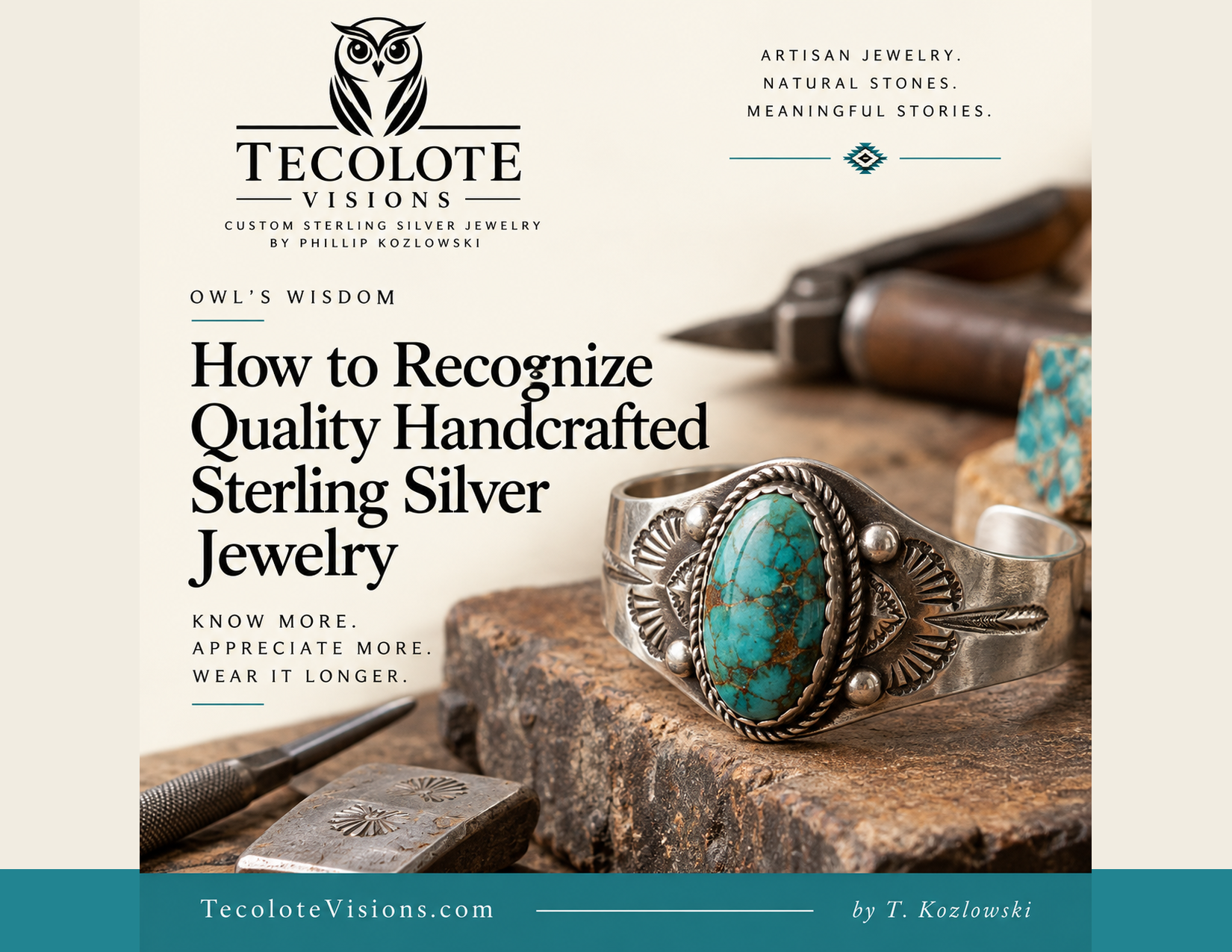
When you look at a beautiful piece of sterling silver jewelry, what do you notice first?
For many of us, it is the stone. A striking piece of turquoise, a beautiful piece of jasper, or an unusual cabochon naturally catches the eye. Then we notice the design surrounding it.
But there is another part of handcrafted jewelry that is easy to overlook: the workmanship.
Learning how to recognize quality handcrafted sterling silver jewelry means looking beyond the stone and paying attention to how the entire piece was constructed.
I have spent a lot of time watching Phillip work at his bench. I have seen a piece begin as a sheet of sterling silver and a rough stone and slowly become something completely different. There are hours of cutting, shaping, fitting, soldering, filing, sanding, polishing, and sometimes starting a section over because it simply was not right.
Most of that work disappears into the finished piece.
And that is exactly the point.
Good craftsmanship should allow you to enjoy the jewelry without immediately noticing all the work required to create it.
So, how can you recognize quality handcrafted sterling silver jewelry when you see it?
Start With the Silver
Sterling silver is made from 92.5 percent silver combined with other metals to give it the strength needed for jewelry. You will frequently see sterling identified with a 925 mark.
That is a good place to start, but a stamp alone does not tell you whether a piece was well made.
Quality also comes from how the silversmith works with the metal.
Sterling silver has to be heated, shaped, soldered, filed, finished, and polished properly. Too little attention during any of those steps can affect how the piece looks, feels, and wears.
When you pick up handcrafted jewelry, pay attention to the silver itself. Does it feel substantial enough for the design? Does the construction seem sturdy? Does the piece feel balanced rather than flimsy?
A delicate design can certainly be beautifully made. Delicate and poorly constructed are not the same thing.
Look Closely at the Solder Work
Soldering joins the different pieces of silver together, and much of the skill involved in silversmithing happens here.
Look at the places where pieces meet.
Quality solder joints should be clean and secure. You should not see obvious gaps or large blobs of solder around the construction. On a well-finished piece, many of those connections almost disappear into the overall design.
This is one of those details I never really noticed before Phillip became a silversmith.
Now I find myself turning jewelry over and looking at the back.
Once you understand how something is made, you begin noticing things you never saw before.

Look at How the Stone Is Set
If the jewelry contains a cabochon, pay attention to how securely the stone sits in its setting.
The bezel—the silver that surrounds and holds the stone—should fit the stone closely. The stone should not rock or rattle inside the setting.
The bezel should also complement the shape of the stone rather than simply forcing the stone into a standard setting.
This is one reason Phillip frequently cuts his own cabochons.
The stone and the silver become part of the same design.
Sometimes the stone determines the jewelry.
Its shape, color, pattern, or natural character may suggest what the finished piece should become. Then Phillip builds the silver setting specifically around that particular stone.
That is very different from choosing a mass-produced setting and finding a stone that will fit inside it.

Turn the Jewelry Over
The front gets most of the attention.
The back often tells you about the maker.
Turn a pendant, ring, or bracelet over and look at the areas that are not normally visible when the jewelry is worn.
Are the edges smooth?
Has the back been finished?
Are solder joints neat?
Does the piece look intentional from both sides?
A handcrafted piece does not have to look identical on the front and back, but the parts you do not normally see should still show care.
Phillip has always been particular about details that most people may never notice.
To me, that says a great deal about craftsmanship.
Quality is what you do even when nobody is looking.

Feel the Edges
Jewelry is meant to be worn.
That sounds obvious, but sometimes we become so focused on appearance that we forget about comfort.
Run your fingers gently along the edges of the piece. They should feel smooth and finished rather than sharp or rough.
Check ring bands, pendant edges, ear wires, clasps, and the backs of settings.
A piece can be visually beautiful and still be uncomfortable if those details are ignored.
Good jewelry should work with the person wearing it.

Check the Moving Parts
If the jewelry has a clasp, hinge, bail, ear wire, or other moving component, use it.
Does it move smoothly?
Does the clasp close securely?
Does the pendant hang naturally from its bail?
Do earrings feel balanced?
These details may seem minor when you are admiring a piece in a display, but they become very important once you start wearing it.
The best craftsmanship combines beauty with function.
Notice the Finish
Sterling silver jewelry can have many different finishes.
Some pieces are polished to a high shine. Others may have a satin or brushed finish. Many Southwestern-inspired designs use patina to darken recessed areas and bring out stamping, texture, and detail.
One finish is not necessarily better than another.
What matters is whether it appears intentional and consistent with the design.
Patina should help reveal the details. Polishing should enhance the shape. Texture should contribute something to the finished piece.
The finish should support the design rather than distract from it.
Handmade Does Not Mean Machine-Perfect
This may be one of the most important things to understand about handcrafted jewelry.
Handmade jewelry may contain tiny variations.
A stamped pattern may not look as mathematically identical as something produced by a machine. A hand-cut component may show subtle differences. Two earrings made individually by hand may be sisters rather than perfectly identical twins.
Those differences are not automatically defects.
They can be evidence of the human hands that created the piece.
There is, however, a difference between natural variation and poor workmanship.
Handcrafted should still mean carefully constructed, thoughtfully finished, and made to last.
The goal is not perfection created by a machine.
The goal is craftsmanship created by a person.
Ask Who Made It
One of the advantages of buying from an artisan is that you can usually ask questions.
What type of silver did you use?
Where did the stone come from?
Did you cut the cabochon?
How was the piece made?
Why did you choose this design?
A maker who knows the materials and created the piece should be able to tell you its story.
That connection is part of what makes handcrafted jewelry different.
At Tecolote Visions, Phillip frequently begins even before the jewelry bench. He selects rough stone, cuts and shapes the cabochon, designs the silver around it, and then creates the finished piece by hand.
You are not simply buying an object at the end of an assembly line.
You are seeing the result of a process.
You can see examples of Phillip’s finished sterling silver work in the Tecolote Visions jewelry gallery.
Look Beyond the Price Tag
Handcrafted jewelry is difficult to compare directly with mass-produced jewelry because you are not purchasing the same thing.
You are paying for the sterling silver and the stone, certainly.
But you are also paying for the maker’s experience, tools, design work, time, and skill.
You are paying for the hours spent creating something that did not exist before.
And when the jewelry is custom made, you are also paying for something created specifically for you.
That does not mean every expensive piece is automatically high quality.
It means price should be considered along with materials, workmanship, originality, and the person who made it.
The Details Tell the Story
The next time you pick up a piece of handcrafted sterling silver jewelry, slow down for a moment.
Look beyond the stone.
Turn the piece over.
Feel the edges.
Look at the solder joints and the setting.
Try the clasp.
Notice how it hangs.
Then look at the piece again as a whole.
Quality handcrafted jewelry is not defined by one spectacular detail. It is the accumulation of dozens of small decisions made throughout the process.
Most of those decisions happened long before you ever saw the finished piece.
That is part of the beauty of handcrafted work.
And when you find a piece where the stone, silver, design, and workmanship all come together, you are holding more than jewelry.
You are holding something another person took the time to create.
And that is worth noticing.
If you have a stone, an idea, or a vision for a piece of sterling silver jewelry you cannot find anywhere else, Phillip would love to hear about it.
If you can visualize it, Phillip can create it.
Leave a Reply